
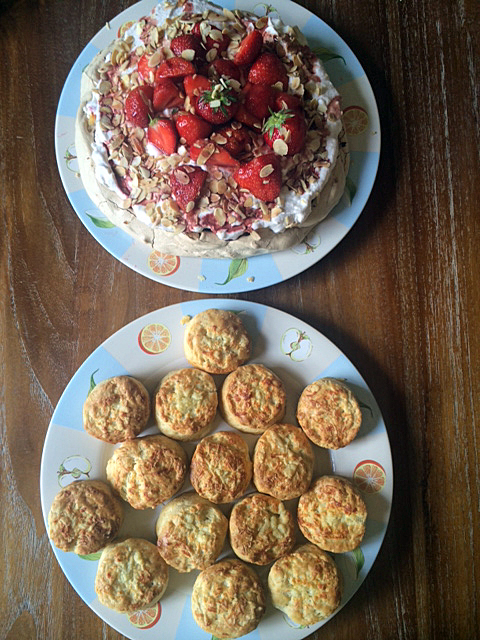
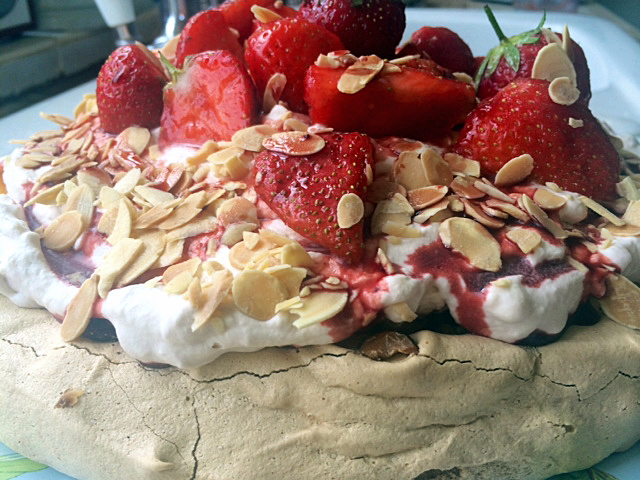
I went out last night for the third evening in a row. As it was Father’s Day today I used the opportunity to make it up to my forbearing husband by making him some very nice things to eat. I did my best ever roast chicken for lunch (thyme butter in-between the breast meat and skin, and half a lemon in the cavity; duck fat roast potatoes) and in the afternoon we had high tea with grandparents: cheese scones and a brown sugar, chestnut and strawberry pavlova.
The Nana Christine in the title is my sister’s mother in law. She is an amazing baker and her cheese scones are delicious. The secret, she says, is not to roll out the dough with a rolling pin but simply flatten it using the heel of your hand. This helps the scones rise on their own and keeps them light. It definitely works – I’ve made them time and time again and they always turn out beautifully. They have a high proportion of cheese in the mix which I think is also key. I’m often disappointed by how un-cheesy a cheese scone can be. I also add a sprinkle of finely grated cheese on top of each scone. I think it looks appealing and makes them taste even better. My two year old was going to eat these so I didn’t add any cayenne pepper, but it’s customary to do so and makes them taste a little ‘tingly’, which I like, so I’m putting it into the recipe as an optional extra.
The pavlova is a Mary Cadogan recipe which I tweaked only very slightly. It was absolutely divine and my best pavlova ever (I do say “This is my best ever” rather often; “You say that every time you cook something” replies my husband; but this time, honestly, it was the truth). The brown sugar gives the meringue a gorgeous caramel flavour and the cornflour and vinegar give it a fabulously gooey middle. I am trying very hard not to go back to the fridge and polish off the whole lot.
Cheese scones Ingredients (makes 16):
- 285g self raising flour
- 85g butter (cold)
- 230g mature cheddar, grated, plus a little extra for the top
- 180ml milk
- salt and pepper
- Pinch of cayenne pepper (optional)
Method:
Preheat the oven to 180 C (fan)
- Mix the flour with the cayenne pepper if you’re going to use it (you can sift them together; you don’t need to sift if you’re not going to add the cayenne)
- Cut the butter into cubes and rub it into the flour with your fingertips until it resembles breadcrumbs
- Add a pinch of salt and a twist or two of black pepper
- Stir in the cheese with a metal fork, so that it’s completely coated with flour. You don’t want the cheese to melt so don’t use your hands.
- Add the milk slowly and mix into a stiff dough with a knife or fork. You may not need all the milk; you may find you need a teeny bit more. You need to use you judgement here – you want a stiff, not gooey dough, but one that you can work with and won’t fall apart.
- Turn the dough out on to a floured surface and knead it lightly.
- Flatten out the dough with the heel of your hand, to about 3cm high. No lower or the scones won’t rise enough.
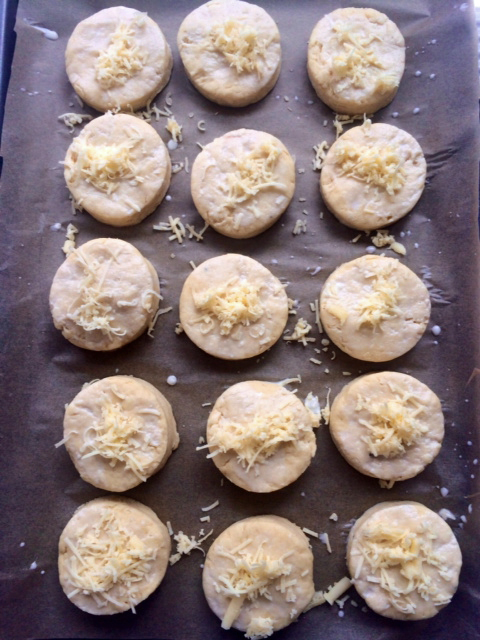
- Use a round cookie cutter (mine is 6cm diameter), cut out your scones and place on baking parchment on a metal baking tray. (When you have cut as many as you can, knead the remaining dough together again and repeat…)
- Glaze them with milk and sprinkle some grated cheese on top of each scone
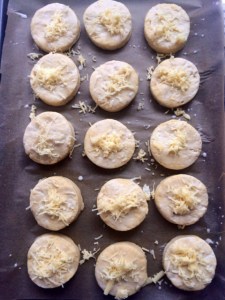
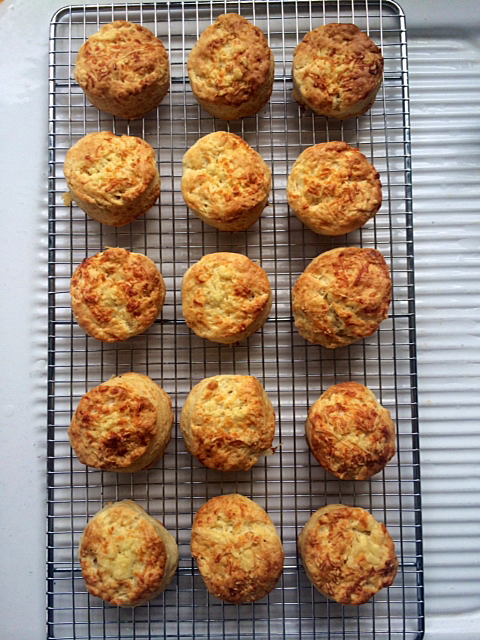
- Bake in the oven for 20 minutes until they are a deep golden colour.
- Remove from the oven and cool on a wire rack, or just eat them immediately, with a large swipe of salted butter. Y U M!
Variation: To make fruit scones replace the cheese with 55g of sugar (golden caster is nice) and 55g sultanas (and obvs leave out the salt, pepper and cayenne too). Add the sugar and sultanas after you’ve rubbed in the butter; dip your cookie cutter in flour before cutting out each scone (to stop it sticking); don’t twist the cutter but bang your hand on the top and then pull it out cleanly; bake near them in a slightly hotter oven – 200C, for 10-15 minutes until golden. You could also use a mixture of milk and lightly beaten egg (about 100ml of milk and 2 medium eggs; reserve a little of the egg to glaze the top of the scones before baking).
Strawberry and brown sugar pavlova
Ingredients:
For the pavlova
- 2 tsp vinegar, any type but not malt. I used white wine vinegar.
- 2 tsp vanilla extract
- 2 heaped tsp cornflour
- 4 large egg whites
- 100g light muscovado/light brown sugar
- 100g golden caster sugar
- 25g whole (not blanched) hazelnuts bashed up a bit (I whizzed mine in my mini blender for a few seconds; you don’t want crumbs but slightly broken up is nice)
For the topping:
- 600g strawberries
- 3 tbsp cassis (blackcurrant liquer)
- 3 tbsp pomegranate molasses
- A tablespoon of icing sugar
- 2 tablespoons of caster sugar
- About 600ml of double cream
- Some toasted flaked almonds (roughly 30g; buy flaked almonds and put them onto a baking sheet in the oven until you can smell them – about 5 mins or so, and they are slightly darkened)
Method:
For the pavlova
- Preheat the oven to 140C/fan 120C. Cut off a piece of baking parchment to fit your baking sheet; using a pencil draw round a 20cm cake tin onto the baking parchment; turn the parchment over (so you don’t get pencil on your pavlova).
- Add the vinegar and vanilla essence to the cornflour, gradually, to make a paste.
- Whisk the egg whites until stiff. I used a freestanding electric mixer but you can easily use a hand held electric whisk.
- Gradually whisk in the sugars, adding a little paste with each addition, until a thick marshmallowy meringue is formed. Don’t overwhisk your egg whites or the mixture will become grainy and you’ll knock all the air out. It will still taste great but won’t be quite as high (I actually over whisked mine a little, and it was still delicious, so don’t get too hung up about it).
- Spread it out in the circle on the baking sheet, swirling the knife (a palette knife is a good implement to use) to make peaks.
- Scatter over the hazelnuts
- Bake for 1 hour, then turn off the oven and leave it to cool. (I made mine the night before and left it in the oven overnight).
For the topping:
- Make a coulis by whizzing up 100g strawberries and a tablespoon of icing sugar with a hand blender, in the small bowl of a food processor or in a mini blender. Sieve the sauce into a bowl and add the cassis and pomegranate molasses.
- Whip the cream with the caster sugar, softly. (It is absolutely essential not to overwhip the cream). Top and slice half the strawberries and fold them into the cream.
- Swirl 3 tbsp of the coulis through the lightly whipped cream.
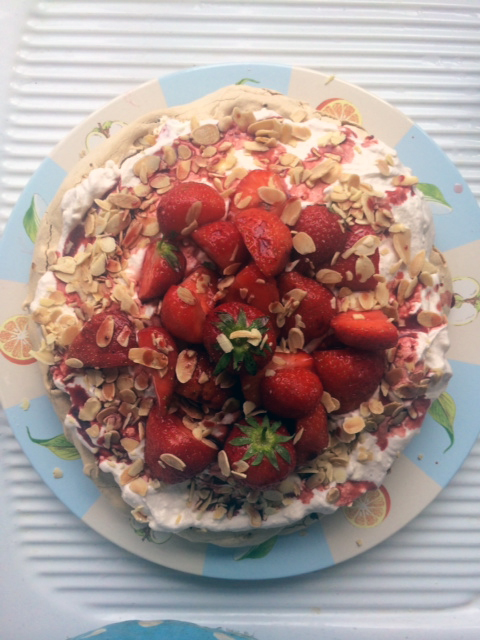
- Put the pavlova onto a large, flat plate. Spoon over the cream, scatter on the remaining strawberries (I left some whole, halved some with their tops still on and topped and halved the rest) and the toasted flaked almonds and drizzle with the sauce. Serve to some very lucky people indeed. Yummmmm!
 Arabella Cooks